


Revival of Karabakh: The Story of Azerbaijan’s Renaissanceh
ABOUT THE BOOK
There are books that document, books that persuade, and books that preserve memory. Revival of Karabakh attempts all three — and does so with striking authority, editorial discipline, and conceptual ambition.
Written by British author Graeme Wilson and commissioned under the auspices of the Karabakh Revival Fund, this work offers one of the most comprehensive and strategically framed narratives ever produced about Azerbaijan’s fair struggle with Armenian occupation.
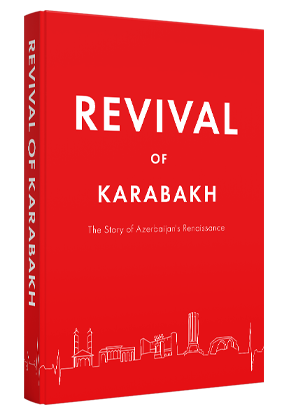
But it is more than a political history. It is a hybrid publication — part historical analysis, part strategic communication tool, and part cultural testimony — that captures both the scars of war and the architecture of a post-conflict renaissance.
Structured in 25 chapters, the book traces the deep historical roots of the Karabakh conflict, beginning with the imperial legacy of border manipulation under Tsarist and Soviet regimes. Author is careful not to reduce the conflict to the events of the 1990s or 2020s; instead, he builds a long-view narrative, allowing the reader to understand how identity, territoriality, and power were distorted across generations — culminating in what he explicitly describes as Armenian military aggression and occupation, sustained for nearly three decades.
The early chapters deal unflinchingly with the historical context, First Karabakh War, the ethnic cleansing of hundreds of thousands of Azerbaijanis, and the geopolitical cynicism that enabled it. What distinguishes Wilson’s treatment of this period is not only its precision but also his attention to the emotional geography of exile. Through archival sources, interviews, and state records, he brings to life the trauma of the IDP generation and the profound disorientation of a country forced to carry part of its Homeland as a memory.
But the book’s thematic core lies in the second half, which documents the liberation of Karabakh in 2020 under the strategic leadership of His Excellency President of the Republic of Azerbaijan Ilham Aliyev, and the unprecedented scale of post-war planning that followed.
Unlike many post-conflict studies that end with ceasefires, Revival of Karabakh begins again at the moment of Victory. What follows is a deeply researched account of demining operations, smart city planning, green energy investments, heritage restoration, and the Great Return of displaced families.
Wilson goes beyond the surface narrative. His treatment of landmine contamination is technical as well as moral. His exploration of the new smart villages and cities being built in Karabakh includes architectural references, socio-economic modelling, and insights from urban planners interviewed for the book. His attention to environmental recovery — especially in the context of ecocide — reflects a recognition that the revival of Karabakh is not only a matter of infrastructure, but of ecological justice.
Revival of Karabakh is also remarkable for how it is told.
It is the first major book in Azerbaijan — and maybe even in the world — to adopt a fully hybrid format, combining print, digital, and artificial intelligence in a seamless reader experience.
What also elevates the book is its commitment to firsthand testimony. Over 40 exclusive interviews—with high-ranking officials, veterans, cultural figures, architects, returnees, and regional experts—are interwoven into the chapters, offering a multi-voiced account of post-war statecraft. These are not quotations pulled from press releases; they are carefully integrated perspectives, conducted by the author himself, and referenced with QR-coded access to full video and text on the book’s companion website.
Regarding form, Revival of Karabakh is one of the most structurally innovative publications to emerge. The book is enriched by:


These are not gimmicks. They are part of a deliberate publishing philosophy: to make the book navigable, searchable, and revisitable — especially for those who will use it as a reference, an educational tool, or a strategic communication asset.
The result is a book that can be read linearly or thematically, on paper or across screens — a book designed not only to be read, but revisited, scanned, searched, and shared.
In tone, the book is measured but firm.
Author writes with clarity and restraint, avoiding polemic in favor of structure and evidence.
He positions President Ilham Aliyev’s leadership as central to both the war’s resolution and the design of post-war peace. The President’s iconic statements appear at key turning points — and are contextualized, not merely quoted, offering insight into how political narrative and national identity were recalibrated after 2020.
Every copy purchased contributes directly to the reconstruction of liberated territories through the Karabakh Revival Fund. But beyond its fundraising role, Revival of Karabakh is a narrative tool — a means of asserting truth, preserving memory, and showcasing Azerbaijan’s model of post-conflict transformation.
It is both a record of devastation and a blueprint for renewal — and in every sense, a product of the revival it describes.
Revival of Karabakh is not designed for casual reading. It is a book of record — one that documents a national challenge, celebrates a Victory, and envisions a national future.
But it is also a book of international relevance, offering a rare and detailed case study of how a post-conflict nation reclaims not only its territory, but its place in history.
Enoy it.