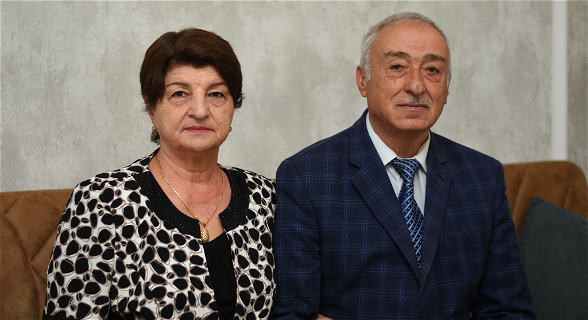
 Rasim Shukurov and Zarifa Manafova
Forcibly displaced people, now residents of Lachin
Rasim Shukurov and Zarifa Manafova
Forcibly displaced people, now residents of Lachin
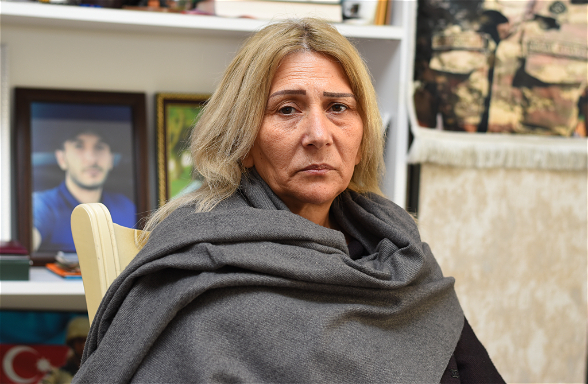
Rasmiya Ahmadova
Mother of a martyr and forcibly displaced personIntro
In this interview, Rasmiya Ahmadova, a forcibly displaced resident of Kalbajar and the mother of a martyr, shares her memories of life in Kalbajar before the occupation and the hardships of displacement. She recounts her family’s forced evacuation, the loss of her son Nijat during the 2020 war, and her pride in his heroism. Rasmiya reflects on her emotional return to Kalbajar after its liberation, the pain of losing her son, and her deep respect for President Ilham Aliyev for reclaiming the lands. Despite the grief, she expresses hope for the future and a longing to return permanently to her homeland.
Summary
In Rasmiya Ahmadova’s opinion, Kalbajar holds a special place in her heart, as it was where she spent the best years of her youth. Born and raised in the region, she was 21 years old when she and her family were forced to leave during the Armenian occupation. Rasmiya recalls that the Armenians evicted them from their homes, and many of her neighbors were martyred. She still carries the trauma of those 30 years of displacement, during which her family struggled to rebuild their lives in Baku.
Rasmiya fondly remembers her grandfather, who was the director of Kalbajar’s first school, and her father, who was a history teacher. Her family was well-respected in the community, and many of their neighbors had higher education. However, their lives were upended when they became IDPs. After leaving Kalbajar, they moved to Mingachevir, where her father and mother-in-law passed away. The Armenians had taken everything from them, and they arrived with only the clothes they were wearing.
The hardest moment for Rasmiya came during the 2020 war, when her son, Nijat, was martyred. Nijat, a graduate of Ganja State University, was a patriotic young man who had worked as a police officer before joining the army. Rasmiya recalls their last conversation on the night of September 26, just before the war began. Nijat was unusually happy, and Rasmiya sensed that it would be their final conversation. On September 27, Nijat was killed in Fuzuli, becoming one of the first martyrs of the war. Rasmiya speaks with immense pride about her son, describing him as a brave and intelligent man who led his comrades through minefields to liberate two villages before he was martyred in the third.
Despite the unbearable loss of her son, Rasmiya remains deeply committed to her country. She is proud of Azerbaijan’s victory and the liberation of Kalbajar, which she believes was made possible by the leadership of President Ilham Aliyev. She recounts how her father predicted that only Heydar Aliyev could liberate the lands, and she expresses gratitude that Ilham Aliyev fulfilled this promise.
Rasmiya describes her emotional return to Kalbajar, where she kissed the soil and felt the presence of her son in the land. She explains that the blood of Azerbaijan’s martyrs, including Nijat, had sanctified the land, making it even more precious. However, Rasmiya acknowledges that despite her joy at returning to Kalbajar, the absence of her son makes it difficult for her to find peace. She is haunted by the loss and constantly searches for her son’s presence, whether in Baku or Kalbajar.
Reflecting on the destruction caused by the Armenians, Rasmiya expresses anger at how they lived in her village for 30 years, burning houses and causing devastation before they left.
In conclusion, Rasmiya’s story is one of grief, resilience, and deep national pride. While she mourns the loss of her son, she takes solace in knowing that his sacrifice contributed to the liberation of Kalbajar. She dreams of one day living permanently in her homeland and hopes that future generations will continue to honor the legacy of Azerbaijan’s martyrs.