 Vahid Hajiyev
Special Representative of the President of the Republic of Azerbaijan in the Jabrayil, Gubadli and Zangilan districts
Vahid Hajiyev
Special Representative of the President of the Republic of Azerbaijan in the Jabrayil, Gubadli and Zangilan districts
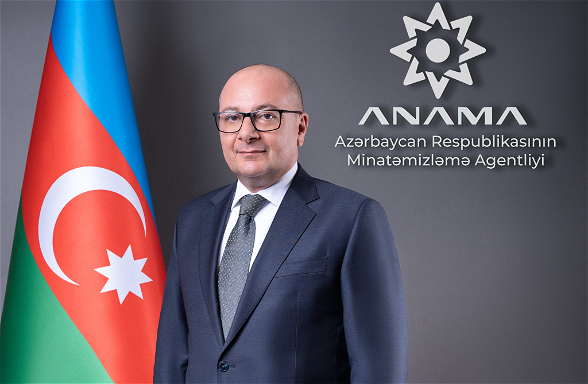
Vugar Suleymanov
Chairman of the Board of the Mine Action Agency of the Republic of AzerbaijanIntro
In this interview, Vugar Suleymanov, Chairman of the Board of the Mine Action Agency of the Republic of Azerbaijan, discusses the agency's efforts to clear landmines from the liberated territories of Karabakh.
He emphasizes the critical role of demining in facilitating the reconstruction and resettlement of internally displaced persons (IDPs). Suleymanov outlines the challenges of coordinating demining operations with the broader reconstruction efforts and highlights the lack of international financial support. He reflects on the commitment of ANAMA and other partners to safely and efficiently clear landmines and the significant progress made despite time and resource pressures.
Summary
In Vugar Suleymanov’s opinion, demining the liberated territories of Karabakh is one of the most urgent tasks Azerbaijan faces in its post-conflict reconstruction. He explains that every year, ANAMA, along with other government agencies, works in coordination under a comprehensive operational plan approved by the cabinet of ministers. This plan prioritizes demining activities to ensure that key infrastructure projects, such as the reconstruction of railways, roads, and power lines, can move forward safely.
Suleymanov emphasizes that there is often very little time between completing demining in an area and the start of reconstruction activities, underscoring the critical need for timely and efficient demining efforts.
Reflecting on the progress made since November 2020, Suleymanov is proud of ANAMA’s achievements. He notes that more than 100,000 hectares of land have been cleared of mines, a significant accomplishment given the scale of the contamination. This achievement was possible through the efforts of various stakeholders, including ANAMA, the Ministry of Defence, the Ministry of Emergency Situations, and international NGOs. Suleymanov credits the rapid scaling of human and operational resources, as well as the training of new demining teams and the acquisition of advanced equipment, for making this progress possible.
Suleymanov acknowledges that Azerbaijan is one of the most heavily mined countries in the world, with the size of the liberated territories comparable to the country of Lebanon. He expresses frustration over the lack of international financial support, pointing out that 95% of the funding for demining operations comes from Azerbaijan’s state budget. In his view, the international community’s underfunding of Azerbaijan’s demining efforts is a significant challenge, especially considering the humanitarian and security implications of the mine problem.
Discussing the technical aspects of demining, Suleymanov explains that ANAMA operates according to internationally recognized standards, including the United Nations' standards for humanitarian mine action. He highlights that ANAMA has been involved in demining operations not only in Azerbaijan but also in other countries around the world. ANAMA’s demining school plays a crucial role in training new deminers and ensuring that all personnel are well-prepared for the challenges they face in the field.
Suleymanov also reflects on the human toll of landmines, noting that since the end of the Second Karabakh War, there have been 337 landmine victims, with 65 of them losing their lives. While ANAMA has been fortunate not to lose any of its deminers to landmines, six individuals have been injured during demining operations. In his view, these statistics underscore the danger of the work and the importance of maintaining strict safety protocols.
One of the key challenges Suleymanov faces is the incomplete and inaccurate minefield information provided by Armenia. While some minefield records were handed over, Suleymanov explains that they are often missing critical details such as geographic coordinates, making them unreliable. Only about 25% of the minefield data provided has been verified as accurate, forcing ANAMA to rely on other methods to locate and clear mines. Despite these obstacles, Suleymanov remains committed to the task, confident that Karabakh will eventually be mine-free.
Suleymanov is particularly passionate about educating the public, especially those returning to the liberated territories, about the dangers of landmines. He describes ANAMA’s large-scale risk education program, which includes collaboration with the Ministry of Education and UNICEF to provide landmine risk education in schools. Additionally, ANAMA trains construction workers and IDPs who are resettling in the region to ensure they are aware of the potential risks and know how to respond if they encounter a landmine.
Looking to the future, Suleymanov is optimistic that ANAMA’s work will make the liberated territories safe for reconstruction and resettlement. He is proud of the resilience shown by the Azerbaijani people, particularly those involved in demining operations, whom he describes as heroes. He believes that, despite the challenges, ANAMA’s efforts are paving the way for a safer and more prosperous future in Karabakh.
Short videos
 ANAMA leads large-scale humanitarian demining
 Mine risk coordination saves lives in Karabakh
 Only a quarter of mine data proved accurate
 From dogs to drones tech aids demining work
 Patriots clear mines to make Karabakh safe