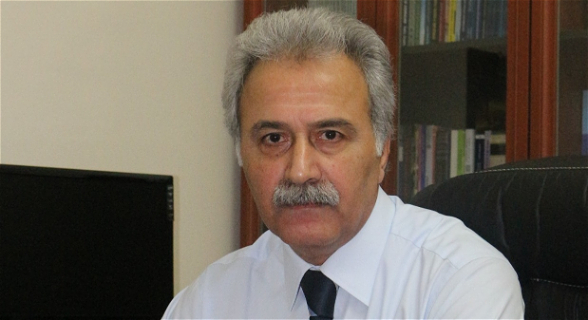
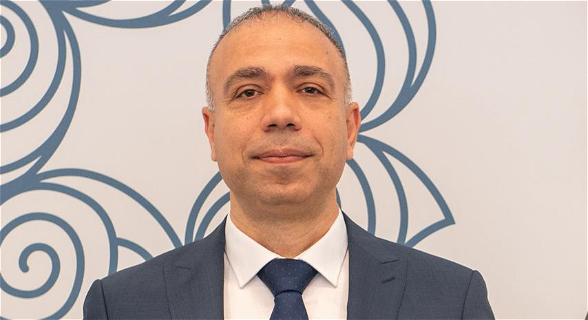
 Elnur Soltanov
Deputy Minister of Energy of the Republic of Azerbaijan
Elnur Soltanov
Deputy Minister of Energy of the Republic of Azerbaijan

Robert Mobili
The leader of the Udi Albanian Christian community of AzerbaijanIntro
In this interview, Robert Mobili, the leader of the Udi Albanian Christian community, discusses the historical erasure of Albania’s Christian heritage by Armenian forces and the challenges of preserving and restoring the Albanian cultural and religious identity in Karabakh.
He emphasizes the efforts of the Armenian church to claim the Albanian churches and rewrite the region's religious history. Mobili highlights the importance of restoring the true heritage of Albanian churches in Karabakh and the ongoing support from the Azerbaijani government to rebuild these religious sites as part of the national revival efforts.
Summary
In Robert Mobili’s opinion, the erasure of Albania’s Christian heritage by Armenian forces has been a systematic and deliberate effort, stretching back over a century. He explains that the Albanian churches in Karabakh, which date back thousands of years, have been claimed by Armenian forces, who not only attempted to destroy their cultural significance but also sought to rewrite the historical narrative. Mobili reflects on the long-standing Armenian attempts to seize Albanian cultural sites, emphasizing that this issue is not merely a matter of religious or historical interest but deeply tied to the control of land. For Armenians, owning the churches was seen as a way to legitimize territorial claims in Karabakh.
Mobili recounts how the Armenians took control of the Albanian churches during the Tsarist Russian era, gradually incorporating them into the Armenian church structure. He stresses that this was part of a larger political strategy by Tsarist Russia, which sought to strengthen Armenian influence in the region. He explains that during this period, the Albanian community faced enormous pressure, with many members either assimilating into Armenian society or fleeing to other regions like Georgia to preserve their identity.
Despite these challenges, Mobili is proud that the Albanian community managed to retain a distinct cultural identity. He points out that even under the Soviet regime, when religious institutions were suppressed, the Albanian heritage survived. Today, Mobili expresses gratitude for the Azerbaijani government's support in restoring the Albanian churches in the liberated territories of Karabakh. He highlights President Ilham Aliyev’s commitment to preserving the cultural and religious diversity of Azerbaijan, a country where the majority Muslim population has always respected and supported minority religious groups.
Mobili reflects on the restoration of Albanian churches as a delicate and complex process. He explains that many of the churches were damaged or altered by Armenian forces, who tried to erase the Albanian elements and replace them with Armenian symbols. Mobili believes that restoring these churches to their original state is essential not only for the Albanian community but for Azerbaijan as a whole, as it underscores the country’s long-standing cultural diversity.
Discussing the practical challenges of restoration, Mobili acknowledges that the small size of the Albanian community, numbering only a few thousand, makes it difficult to fully restore all the churches. However, he believes that the community can still play a significant role in preserving its heritage, especially with the help of historians and researchers from both Azerbaijan and abroad. He mentions collaborations with Norwegian scholars and other international experts who have helped uncover historical records and manuscripts that confirm the existence of a distinct Albanian Christian heritage in the region.
Mobili is particularly concerned about the ongoing efforts by Armenians to claim the Albanian churches in the post-war period. He warns that Armenians are trying to position themselves as the rightful heirs of these religious sites, which he sees as an attempt to plant the seeds of future conflicts. In his view, the international community must recognize the true history of these churches and support efforts to preserve them as part of Azerbaijan’s cultural heritage.
Ultimately, Mobili remains hopeful about the future. He believes that with continued support from the Azerbaijani government and the international community, the Albanian churches in Karabakh can be fully restored, and the Albanian cultural identity can be preserved for future generations. He sees this as an essential part of the broader effort to rebuild Karabakh and ensure that it remains a region of cultural and religious diversity.